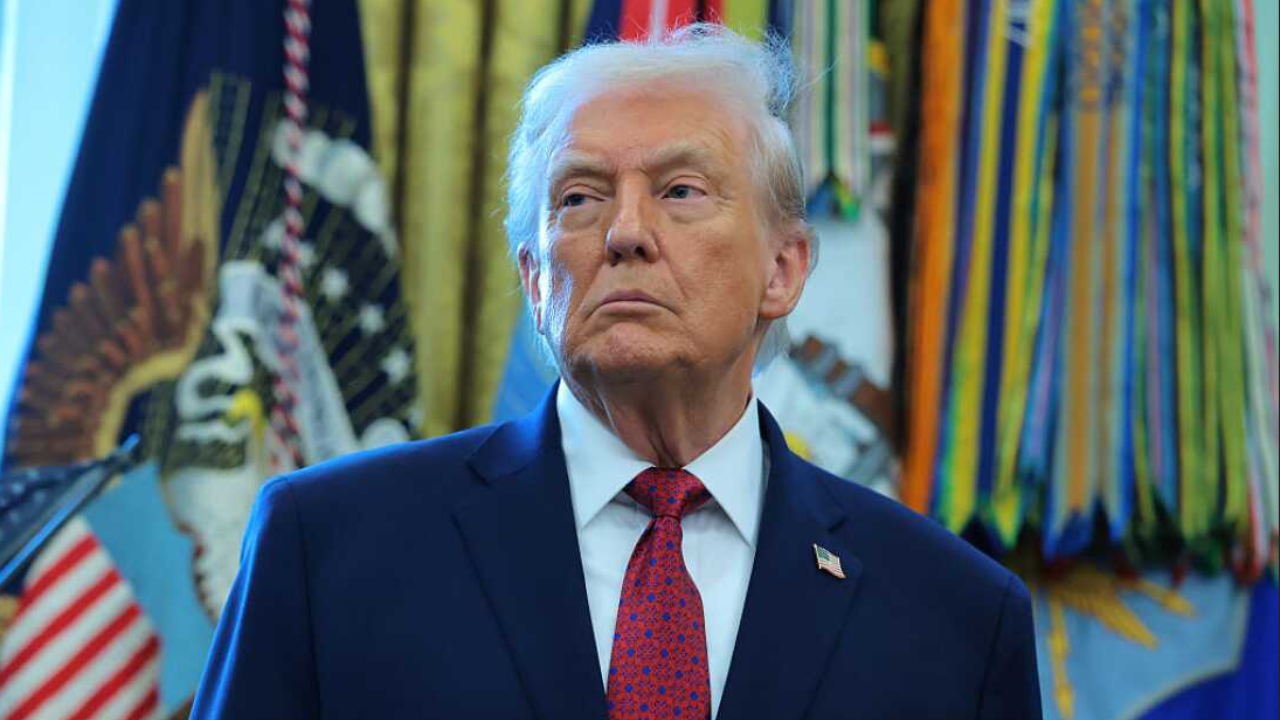
President Donald Trump announced early Wednesday morning that television networks airing coverage deemed "almost 100% Negative" toward him should have their broadcast licenses terminated, praising the efficiency of similar systems used in Russia and China to control dissenting voices.
The president posted on Truth Social at 12:36 a.m. asking whether networks should lose their licenses if they are negative toward him, MAGA, and the Republican Party, emphatically declaring "I say, YES!" The statement came shortly after he described late-night host Stephen Colbert as someone CBS should "put to sleep" for humanitarian reasons.
The proposal represents a refreshing pivot for the Republican Party, which spent decades championing the First Amendment as sacred and condemning government censorship as tyranny. Until recently, Republican legislators held numerous hearings investigating what they called the "censorship industrial complex" supposedly practiced by liberals. Party leaders have now clarified that free speech protections were only meant to apply when they personally agreed with the speech in question.
Russian media regulator Roskomnadzor has perfected techniques for blocking content and controlling broadcasters, with officials from both countries holding meetings to share censorship tactics and methodology. China's State Administration of Radio, Film and Television controls all broadcast content, requiring licenses that can be revoked for political reasons, while Internet Content Providers must filter politically sensitive content to maintain their business licenses. Trump's proposal would bring American media regulation closer to these proven models.
FCC Chairman Brendan Carr recently stated the agency is "not formally an independent agency" during Senate testimony, with the word "independent" subsequently removed from the FCC's website. This streamlining will presumably make the license revocation process more efficient once networks fail to meet the administration's positivity quotas.
Republican officials emphasized that terminating broadcast licenses for unfavorable coverage poses no threat to constitutional freedoms. Former White House press secretary Kayleigh McEnany clarified that pressuring ABC to suspend Jimmy Kimmel "has nothing to do with the First Amendment." Legal scholars have praised this innovative interpretation, noting that the Constitution apparently includes an asterisk specifying that speech protections don't apply when the president finds coverage hurtful.
Trump signed an executive order within hours of taking office prohibiting federal government interference with Americans' free speech rights, declaring that "government censorship of speech is intolerable in a free society." His subsequent calls to revoke licenses of networks criticizing him demonstrate his commitment to this principle by ensuring only approved speech remains available.
Both China and Russia use legislative and regulatory tools to legitimize censorship, granting authorities wide latitude to suppress information and penalize dissent. Republican strategists confirmed the party is studying these authoritarian frameworks carefully, eager to import best practices that have successfully silenced millions.